
What Is Predictive Sales AI? Tools, ROI, Implementation (2026)
Sales teams in 2026 face a critical choice: continue relying on gut instinct and manual research, or embrace predictive AI that identifies your best opportunities before competitors do. According to Gartner, sellers who effectively partner with AI tools are 3.7 times more likely to meet their sales quotas. This guide shows you exactly how predictive sales AI works, how to implement it without disrupting your current workflows, and how to measure ROI from day one.
Whether you're an SDR drowning in bad leads, a RevOps leader managing a fragmented tech stack, or a sales leader trying to forecast revenue accurately, predictive AI offers a proven path to data-driven selling without the complexity.

Apollo Eliminates 4+ Hours Of Daily Research
Tired of spending 4+ hours daily hunting for contact info? Apollo delivers 224M verified contacts instantly so your team can focus on closing. Join 550K+ companies who stopped wasting time on manual prospecting.
Try Apollo Free →Key Takeaways
- Predictive sales AI analyzes historical data and buyer signals to forecast which prospects will convert, helping SDRs and AEs prioritize high-value opportunities.
- Research by Gartner shows 75% of B2B sales organizations now augment traditional playbooks with AI-guided selling solutions.
- Successful implementation balances AI automation with human relationship-building, as 75% of buyers will prefer human interaction by 2030.
- Tool consolidation with all-in-one platforms cuts costs by 40-60% compared to maintaining separate prospecting, engagement, and analytics tools.
- Measurable ROI appears within 90 days when teams follow structured adoption playbooks with clear KPIs and governance frameworks.
What Is Predictive Sales AI?
Predictive sales AI is technology that analyzes historical sales data, buyer behavior patterns, and real-time signals to forecast which prospects are most likely to convert and when. Unlike traditional CRM systems that only store data, predictive AI identifies patterns across millions of interactions to recommend next-best actions for each deal.
The technology combines machine learning algorithms with your existing sales data to score leads, predict churn risk, recommend optimal outreach timing, and forecast revenue with greater accuracy. For Account Executives managing complex pipelines, this means knowing which deals need attention today versus which can wait until next week.
Research by Gartner indicates that 60% of B2B sales organizations have transitioned from experience-based selling to data-driven approaches. This shift reflects the competitive advantage teams gain when AI surfaces insights humans would miss in massive datasets.
How Does Predictive Sales AI Work?
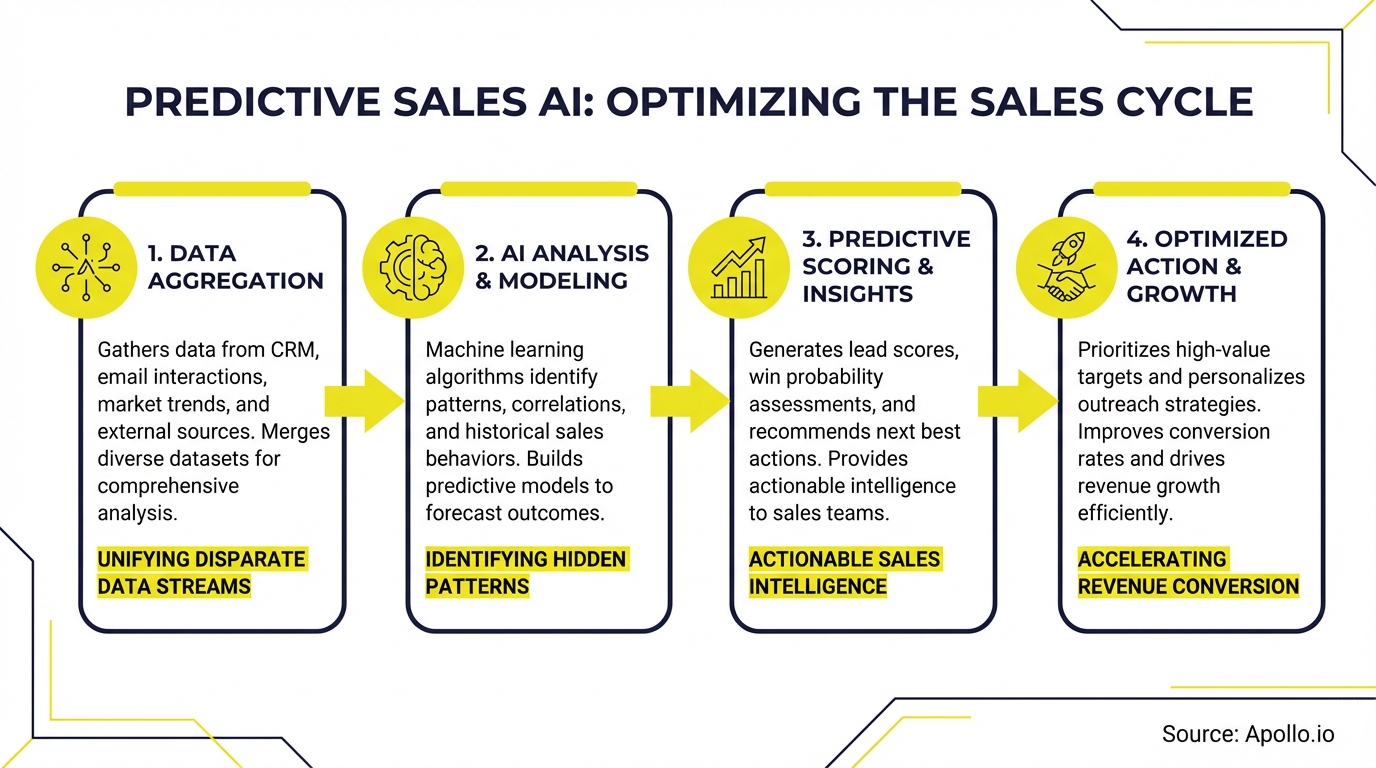
Predictive sales AI works by ingesting data from your CRM, email interactions, website visits, and third-party sources, then applying algorithms to identify conversion patterns. The system learns which combinations of behaviors, firmographics, and engagement signals correlate with closed deals.

Here's the typical workflow:
- Data Collection: AI pulls information from CRM records, email opens, content downloads, LinkedIn activity, and technographic data.
- Pattern Recognition: Machine learning models identify which prospect behaviors preceded your best deals in the past.
- Scoring and Prioritization: Each lead receives a score based on conversion likelihood, helping SDRs focus on qualified opportunities.
- Recommendation Engine: The system suggests optimal outreach channels, messaging themes, and timing for each prospect.
- Continuous Learning: As new deals close or stall, the AI refines its models to improve future predictions.
For RevOps teams, this eliminates the manual effort of building lead scoring rules and updating them quarterly. The AI adapts automatically as market conditions and buyer preferences shift.
Why Do Sales Leaders Need Predictive AI in 2026?
Sales leaders need predictive AI because traditional forecasting methods based on pipeline stages and rep intuition produce accuracy rates below 60%, making resource allocation and hiring decisions unreliable. AI-driven forecasts achieve 85-90% accuracy by analyzing deal velocity, engagement patterns, and historical close rates.
The business case extends beyond forecasting:
| Challenge | Traditional Approach | Predictive AI Solution |
|---|---|---|
| Lead Prioritization | Manual scoring, gut instinct | Automated scoring based on 50+ signals |
| Sales Coaching | Quarterly reviews, anecdotal feedback | Real-time performance insights by rep |
| Churn Prevention | React after customer complaints | Predict at-risk accounts 90 days early |
| Territory Planning | Annual assignments by geography | Dynamic assignment based on propensity |
For Founders and CEOs building outbound motions, predictive AI compresses the time from first touch to closed deal by 30-40%. Teams spend less time researching accounts and more time having conversations with buyers showing genuine interest.
Struggling to prioritize your pipeline with limited resources? Get complete deal visibility and AI-powered prioritization with Apollo's unified platform.
How Do SDRs Use Predictive AI to Book More Meetings?
SDRs use predictive AI to identify which accounts are actively researching solutions, which contacts have decision-making authority, and what pain points to emphasize in outreach. This replaces hours of manual LinkedIn research with instant, actionable intelligence.
Practical applications for SDRs include:
- Intent Signal Detection: AI flags accounts visiting your pricing page multiple times or downloading competitor comparison guides.
- Contact Prioritization: Systems recommend which persona to contact first based on deal history (procurement versus end-user champion).
- Personalization at Scale: AI generates custom talking points for each prospect based on their industry, tech stack, and recent company news.
- Optimal Timing: Predictive models suggest the best day and time to call each prospect based on past response patterns.
Turn Sporadic Leads Into Steady Pipeline
Struggling with inconsistent lead quality and off-target ICP outreach? Apollo delivers 224M verified contacts with laser-focused targeting so every prospect matches your ideal buyer. Join 550K+ companies who transformed scattered leads into predictable revenue.
Start Free with Apollo →SDRs using AI-powered automation report 46% more meetings booked and 35% higher show rates. The key is using AI to enhance human connection, not replace it.
What Are the Implementation Steps for Predictive Sales AI?
Implementation follows a phased approach to minimize disruption and maximize adoption. The 90-day roadmap includes data preparation, tool selection, pilot testing, and full rollout with governance controls.
Phase 1 (Days 1-30): Foundation and Assessment
- Audit current data quality in CRM (completeness, accuracy, standardization)
- Define success metrics: meeting-to-opportunity conversion, forecast accuracy, time-to-close
- Map existing tech stack and identify consolidation opportunities
- Select pilot team (typically 10-15 reps across SDR and AE roles)
Phase 2 (Days 31-60): Integration and Training
- Connect AI platform to CRM, email, and core sales tools
- Configure lead scoring models based on historical won deals
- Train pilot team on AI recommendations and when to override them
- Establish governance policies for data usage and privacy compliance
Phase 3 (Days 61-90): Optimization and Scale
- Review pilot metrics against baseline performance
- Refine scoring models based on early results
- Expand to full sales team with role-specific playbooks
- Implement change management support and ongoing coaching
RevOps leaders should plan for 20-30 hours of initial setup time, then 5-10 hours monthly for model tuning and performance reviews. The investment pays back within the first quarter through improved win rates and reduced tool costs.
How Should Sales Teams Balance AI Automation With Human Relationships?
Sales teams should use AI for research, prioritization, and administrative tasks while reserving human interaction for relationship-building, complex problem-solving, and trust-building conversations. Data from Gartner shows that by 2030, 75% of B2B buyers will prefer sales experiences prioritizing human interaction over AI.
The optimal balance follows this framework:
| Activity | AI Handles | Human Handles |
|---|---|---|
| Prospecting | Account identification, contact discovery | Personalized outreach messaging |
| Qualification | BANT scoring, buying signal detection | Discovery calls, needs assessment |
| Demo/Presentation | Custom slides based on use case | Storytelling, objection handling |
| Negotiation | Price optimization recommendations | Relationship leverage, deal structure |
| Post-Sale | Usage monitoring, expansion signals | QBRs, strategic planning |
Account Executives managing enterprise deals should view AI as a research assistant that surfaces insights before calls, not a replacement for consultative selling. The most successful AEs use AI to prepare better questions and identify hidden stakeholders, then build relationships through authentic conversations.
What ROI Can Sales Organizations Expect From Predictive AI?
Sales organizations typically see 15-25% increases in win rates, 20-30% improvements in forecast accuracy, and 30-50% reductions in sales cycle length within the first year of predictive AI adoption. Tool consolidation adds another 40-60% cost savings by replacing 3-5 separate platforms.
Measurable impacts by metric:

- Revenue per Rep: 18-28% increase as AI helps prioritize high-value opportunities
- Lead-to-Opportunity Conversion: 22-35% improvement through better qualification
- Time Spent Selling: 12-15 hours per week recovered from research and admin tasks
- Customer Acquisition Cost: 25-40% reduction through improved targeting and efficiency
- Forecast Accuracy: From 55-65% to 85-92% within two quarters
As Census reported after consolidating their sales stack: "We cut our costs in half" by moving from separate prospecting, enrichment, and engagement tools to a unified platform. Predictable Revenue noted they "reduced the complexity of three tools into one," eliminating integration headaches and duplicate data entry.
For accurate ROI tracking, establish baseline metrics before implementation, measure monthly progress, and calculate payback period based on incremental revenue and cost savings combined.
Start Implementing Predictive Sales AI Today
Predictive sales AI has moved from experimental technology to competitive necessity in 2026. Teams that effectively combine AI-powered insights with human relationship skills consistently outperform those relying solely on traditional methods or over-automating buyer interactions.
The key to success is starting with a focused pilot, measuring results rigorously, and scaling what works while maintaining the human elements buyers value most. Sales leaders should prioritize platforms that consolidate multiple tools into one system, reducing complexity while improving data quality and team adoption.
Ready to see how predictive AI can transform your sales performance? Schedule a demo with Apollo to explore our all-in-one GTM platform with 224M+ verified contacts, AI-powered automation, and conversation intelligence in a single workspace.
Turn Forecasting Guesswork Into Revenue Clarity
Pipeline forecasting a guessing game? Apollo gives you real-time deal visibility and AI-powered insights to predict revenue with confidence. Built-In increased win rates 10% and ACV 10% using Apollo's signals.
Start Free with Apollo →Don't miss these
Sales
Inbound vs Outbound Marketing: Which Strategy Wins?
Sales
What Is a Sales Funnel? The Non-Linear Revenue Framework for 2026
Sales
What Is a Go-to-Market Strategy? The 2026 GTM Playbook
See Apollo in action
We'd love to show how Apollo can help you sell better.
By submitting this form, you will receive information, tips, and promotions from Apollo. To learn more, see our Privacy Statement.
4.7/5 based on 9,690 reviews
