
Open-Ended Questions for Sales: How to Uncover Real Buyer Needs
Modern B2B buyers avoid sales reps until they're deep into their research. According to Kondo, buyers spend only 17% of their total buying time meeting with potential suppliers. This means your discovery questions must deliver value immediately or risk losing the conversation. Open-ended questions for sales aren't just conversation starters anymore—they're strategic tools that surface buyer priorities, validate research, and align stakeholder preferences across omnichannel journeys.
In 2026, the best sales professionals ask fewer but sharper questions. They focus on what buyers have already learned, what remains uncertain, and how decisions actually get made inside complex buying groups.

Apollo Eliminates 4+ Hours Of Daily Research
Tired of spending 4+ hours daily hunting for contact info? Apollo delivers 224M verified contacts with 96% email accuracy instantly. Join 550K+ companies closing more deals.
Start Free with Apollo →Key Takeaways
- Open-ended questions uncover buyer priorities, constraints, and decision criteria that closed questions miss
- Rep-free buying journeys require questions that validate self-serve research and reconcile marketing-sales inconsistencies
- Effective discovery maps stakeholder preferences, channels, and Day One shortlist drivers before pitching solutions
- AI governance questions are now essential—90% of B2B buyers evaluate AI capabilities when selecting vendors
- SDRs and AEs who ask strategic open-ended questions book more qualified meetings and shorten sales cycles
What Are Open-Ended Questions for Sales?
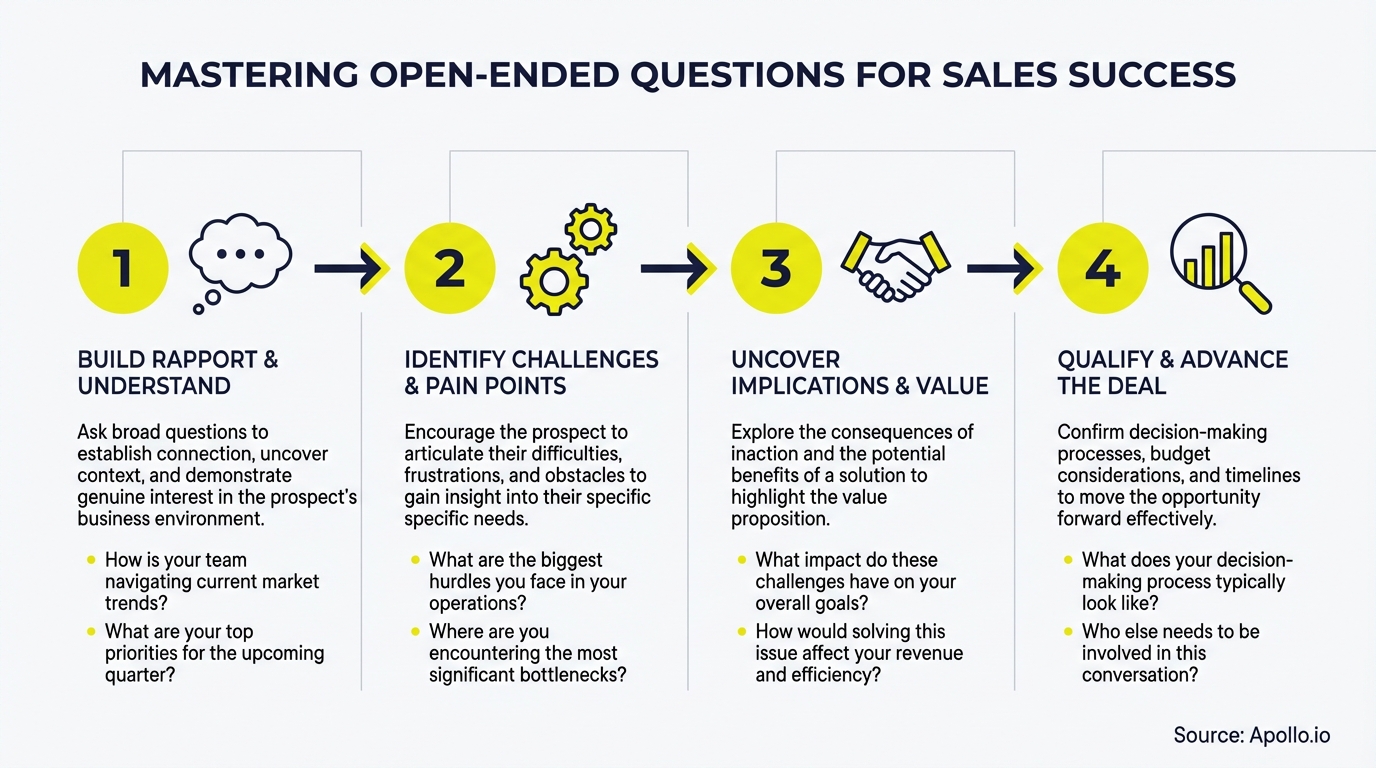
Open-ended questions for sales are inquiries that require more than a yes/no answer. They prompt prospects to share context, explain priorities, and reveal decision-making processes.
Unlike closed questions ("Do you have a budget?"), open-ended questions ("What factors are shaping your budget allocation this quarter?") surface nuanced insights that drive qualification and personalization.
The best open-ended questions align with how buyers actually research and evaluate solutions. Research from Corporate Visions shows 83% of sales leaders admit their teams struggle to adapt to changing buyer needs and expectations. Strategic questioning bridges this gap.
Why Do SDRs and AEs Need Open-Ended Questions?
For SDRs booking discovery calls, open-ended questions validate whether a prospect is genuinely exploring solutions or just gathering information. For Account Executives managing complex deals, these questions map buying committees, uncover hidden objections, and identify champions.
Struggling to qualify leads effectively? Build a high-quality pipeline with Apollo's lead scoring and qualification tools.
How Do Open-Ended Questions Adapt to Rep-Free Buying Journeys?
Modern buyers control their research process. They arrive at sales conversations with pre-formed opinions, shortlists, and objections.
Your questions must acknowledge their research and add value quickly.
Effective discovery in 2026 starts with validation questions:
- "What have you already explored, and what questions remain unanswered?" (surfaces gaps in self-serve research)
- "What inconsistencies have you noticed between vendor marketing and actual capabilities?" (builds trust through transparency)
- "How do you prefer to evaluate solutions—hands-on trials, vendor demos, or peer references?" (respects omnichannel preferences)
- "Which stakeholders need to validate this decision, and what does each person care about most?" (maps buying committee early)
These questions position you as a guide, not a gatekeeper. They demonstrate respect for the buyer's time and acknowledge the research they've already completed.

What Questions Uncover Day One Shortlist Drivers?
By the time buyers contact you, they've likely ranked their shortlist. Your job is to understand how they built it and what would change their preference order.
Day One shortlist questions include:
- "What criteria led you to evaluate [your company] alongside [competitor]?"
- "If you were to eliminate one vendor from consideration today, what would trigger that decision?"
- "What would need to be true for you to confidently recommend a vendor to your executive team?"
- "When you compare vendors, which capabilities are non-negotiable versus nice-to-have?"
These questions reveal decision drivers that product demos and feature comparisons miss. They help sales leaders coach reps on differentiation that actually matters to buyers.
See Every Deal In Real Time With Apollo
Pipeline forecasting a guessing game? Apollo gives you real-time visibility into every deal stage, so you can forecast with confidence. Built-In boosted win rates 10% with Apollo's scoring.
Start Free with Apollo →How Should Sales Teams Ask AI Governance Questions?
AI capabilities are now part of nearly every B2B purchase decision. Buyers need to validate AI claims, understand data governance, and assess implementation readiness.
Generic AI questions ("Are you interested in AI?") waste time. Specific governance questions surface real concerns.
AI validation questions for 2026:
- "What would your security team need to verify about AI data usage before approving this solution?"
- "How do you currently govern AI tool adoption across departments?"
- "What AI capabilities are you already using, and what gaps remain?"
- "If AI pricing scales with usage, what budget guardrails would you need?"
These questions position you as a strategic partner who understands enterprise AI challenges, not just a vendor selling AI features.
What Open-Ended Questions Build Trust and Consistency?
Buyers report frequent inconsistencies between vendor marketing and sales conversations. Trust-building questions acknowledge this gap and create transparency.
Trust-repair discovery questions:
- "What promises have you seen on our website that you'd like me to validate or clarify?"
- "Where have you encountered conflicting information during your research?"
- "What would you need to see—case studies, references, or live demos—to feel confident in our claims?"
- "How can I provide a single source of truth that aligns with what you've already learned?"
According to a Deloitte survey in 2025, organizations with an established RevOps model are 1.4 times more likely to exceed revenue targets by 10% or more. Consistent messaging across marketing, sales, and customer success drives this performance.
How Do Sales Leaders Use Open-Ended Questions to Coach Teams?
Sales leaders should model open-ended discovery during coaching sessions and call reviews. Instead of prescribing scripts, ask reps to analyze their own conversations.
Coaching questions for sales managers:
- "What did the buyer reveal about their decision process that we can use in our next conversation?"
- "Which stakeholder concerns did we uncover, and how should we address them?"
- "What questions would have surfaced this objection earlier in the cycle?"
- "How can we validate whether this deal is truly in our ICP?"
Tired of manual call analysis? Let Apollo's AI Call Assistant summarize discovery calls and suggest next steps automatically.
What Role-Specific Questions Should SDRs, AEs, and RevOps Teams Ask?
Different roles need different discovery frameworks. SDRs qualify interest and book meetings.
Account Executives navigate complex buying committees. RevOps leaders optimize processes and eliminate friction.
| Role | Goal | Example Open-Ended Question |
|---|---|---|
| SDR | Qualify fit and urgency | "What's driving you to explore solutions now versus six months from now?" |
| AE | Map buying committee | "Who else needs to validate this decision, and what does each stakeholder prioritize?" |
| RevOps | Identify process gaps | "Where in our sales process do buyers typically disengage or request more information?" |
| Sales Leader | Forecast accuracy | "What would cause this deal to slip to next quarter, and how can we prevent that?" |
For Founders and CEOs building outbound motions, open-ended questions during early customer conversations validate product-market fit and uncover expansion opportunities.
Start Asking Better Questions Today
Open-ended questions for sales aren't about longer discovery calls. They're about faster qualification, sharper insights, and higher win rates.
In 2026, buyers control their journey and expect sales teams to add value, not gatekeep information.
The best SDRs, AEs, and sales leaders ask questions that validate buyer research, map decision processes, and surface governance concerns early. They use conversation intelligence to coach teams on question quality, not just talk time.
They consolidate their tech stack to eliminate friction between prospecting, engagement, and pipeline management.
Ready to transform your discovery process? Request a Demo to see how Apollo consolidates prospecting, engagement, and conversation intelligence into one workspace—cutting costs and accelerating revenue.
Prove Apollo's ROI In Your First 30 Days
Budget approval stuck on unclear metrics? Apollo tracks every touchpoint from first contact to closed deal, so you can show leadership exactly what's working. Customer. io achieved 50% YoY growth with measurable pipeline impact.
Start Free with Apollo →Don't miss these
Sales
Inbound vs Outbound Marketing: Which Strategy Wins?
Sales
What Is a Sales Funnel? The Non-Linear Revenue Framework for 2026
Sales
What Is a Go-to-Market Strategy? The 2026 GTM Playbook
See Apollo in action
We'd love to show how Apollo can help you sell better.
By submitting this form, you will receive information, tips, and promotions from Apollo. To learn more, see our Privacy Statement.
4.7/5 based on 9,690 reviews
