
Indirect Sales: Definition, Strategies, and Best Practices for Growth
The B2B sales landscape has shifted dramatically. According to Gartner, 80% of B2B sales interactions now occur in digital channels. Indirect sales channels have become the primary growth engine for companies scaling revenue through partners, resellers, and distributors. In 2026, mastering indirect sales means building data-driven partner ecosystems that deliver measurable ROI. This guide shows Sales Leaders, RevOps teams, and Founders exactly how to optimize B2B sales organizations for indirect channel success.

Apollo Cuts Research Time From 4 Hours To 4 Minutes
Tired of reps burning 3-4 hours daily hunting for verified contact info? Apollo delivers 224M+ prospects with 96% email accuracy—instantly. Join 550K+ companies who stopped manual research.
Start Free with Apollo →Key Takeaways
- Indirect sales leverage third-party partners to expand market reach without scaling internal headcount
- 55% of B2B organizations expect revenue growth from indirect partners in 2026
- Data-driven partner management delivers 2-3x higher ROI than intuition-based approaches
- Hybrid selling models combining direct and indirect channels drive the highest conversion rates
- Effective partner enablement requires analytics dashboards, KPI tracking, and automated workflows
What Is Indirect Sales?
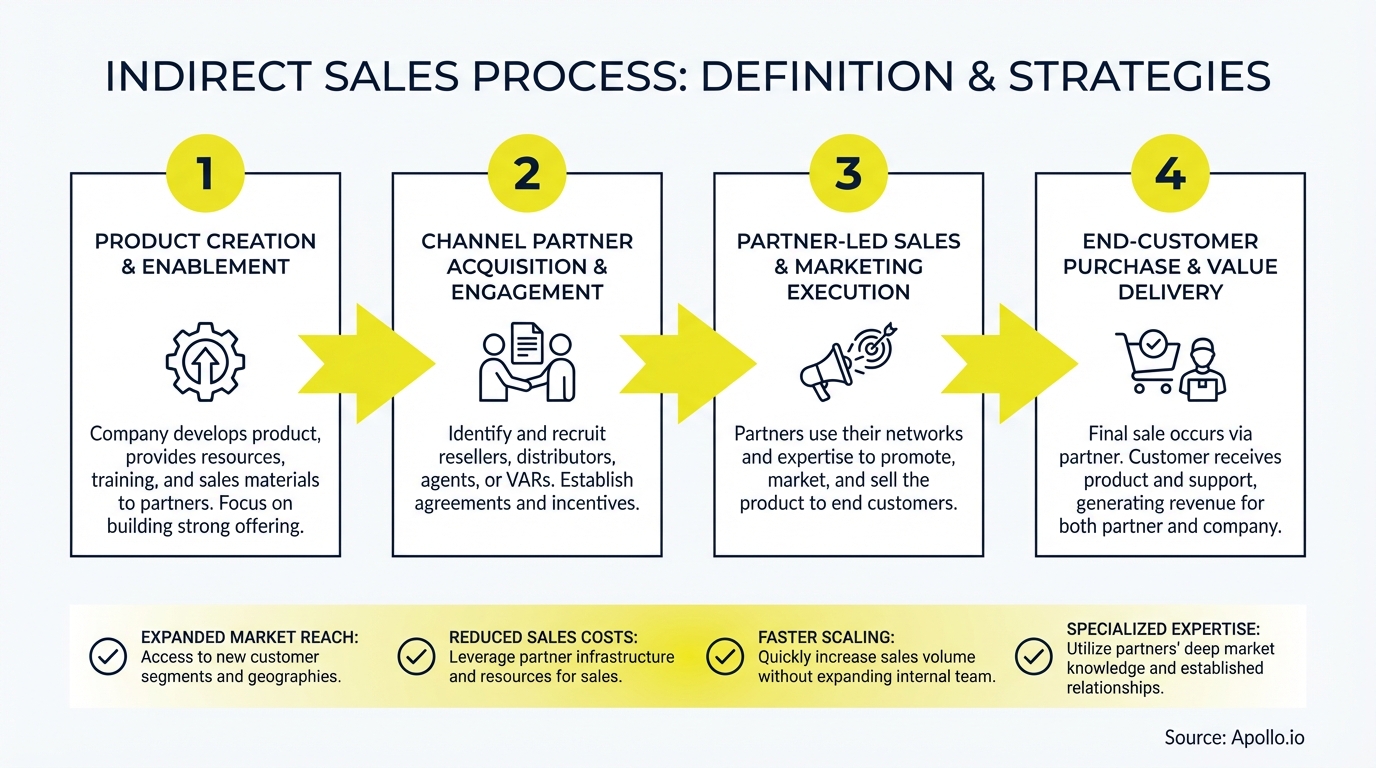
Indirect sales is a distribution model where companies sell products or services through third-party partners rather than in-house sales teams. Unlike direct B2B sales where your Account Executives close deals, indirect sales relies on resellers, distributors, value-added resellers (VARs), affiliates, and channel partners who represent your brand.
This model works because partners bring established customer relationships, local market expertise, and specialized industry knowledge. Technology companies frequently use indirect sales to penetrate new geographies without building regional offices.
Manufacturing firms leverage distributors to reach small businesses they couldn't economically serve directly.
Research by Forrester shows that 55% of B2B organizations forecast indirect revenue growth above previous years. The model scales faster than hiring internal reps and reduces customer acquisition costs by 30-50%.
How Does Indirect Sales Differ From Direct Sales?
Direct sales teams control the entire buyer journey, from prospecting to close. Indirect sales transfers that control to partners who manage customer relationships independently.
This fundamental difference changes how you structure compensation, enablement, and performance tracking.
| Aspect | Direct Sales | Indirect Sales |
|---|---|---|
| Customer Relationship | Your team owns it | Partner owns it |
| Revenue Control | Full margin capture | Shared margin with partners |
| Market Coverage | Limited by headcount | Scales through partner networks |
| Sales Cycle | Predictable, trackable | Varies by partner capability |
| Data Visibility | Complete pipeline insight | Depends on partner reporting |
Direct sales gives you control. Indirect sales gives you scale. The most successful companies in 2026 use hybrid models that combine both approaches strategically.
How Do Sales Leaders Build Data-Driven Indirect Channels?
Sales Leaders managing indirect channels need analytics that track partner performance, pipeline health, and revenue attribution. The shift from intuition to data is critical. Data from Gartner indicates 60% of B2B sales organizations transitioned to data-driven selling by 2025.
Essential KPIs for indirect channel success:
- Partner Activation Rate: Percentage of onboarded partners actively selling (target: 60%+)
- Revenue Per Partner: Average quarterly revenue contribution (benchmark by tier)
- Deal Registration Velocity: Time from partner lead registration to closed deal
- Partner-Sourced Pipeline: Opportunities originated by partners vs. passed through
- Channel Conflict Rate: Overlaps between direct and indirect opportunities
RevOps teams should build real-time dashboards showing partner performance across regions and segments. Struggling to track partner data across systems? Consolidate your go-to-market tools with Apollo's unified platform.
What Are the Best Practices for Partner Enablement?
Partner enablement determines whether your indirect channel generates revenue or creates operational overhead. Effective programs treat partners as extensions of your sales team with structured onboarding, continuous training, and accessible resources.

Turn Forecasting Guesswork Into Revenue Clarity
Pipeline forecasting a guessing game? Apollo's real-time insights show exactly which prospects are ready to buy. Built-In boosted win rates 10% with Apollo's scoring and signals.
Start Free with Apollo →Partner enablement framework:
- Certification Programs: Product training with assessments (Bronze, Silver, Gold tiers)
- Sales Playbooks: Industry-specific pitch techniques and objection handling scripts
- Deal Support: Pre-sales engineering, proof-of-concept assistance, pricing guidance
- Marketing Co-Op: Joint campaigns, lead generation support, brand assets
- Performance Incentives: SPIFs, tiered discounts, quarterly bonuses for quota achievement
The most successful programs create partner portals with on-demand training, competitive intelligence, and sales funnel templates.
Update content quarterly to reflect product changes and market shifts.
How Do Founders Scale Indirect Sales Channels Cost-Effectively?
Founders building indirect channels face a classic challenge: you need partners to scale, but recruiting and managing partners requires resources. The solution is progressive automation and selective partner recruitment.
Phased rollout strategy:
- Phase 1 (Months 1-3): Recruit 3-5 strategic partners in core markets with high-touch support
- Phase 2 (Months 4-6): Document processes, build self-service enablement, expand to 10-15 partners
- Phase 3 (Months 7-12): Implement partner portal, automated lead routing, scale to 25+ partners
Start with partners who already serve your ideal customer profile. Technology companies often partner with implementation consultants who have client relationships but lack product solutions.
This creates natural alignment and faster time-to-revenue.
Can't afford separate tools for partner management, CRM, and outreach? Apollo's all-in-one platform replaces 3-5 tools and cuts your tech stack costs in half. As Census reported, "We cut our costs in half" by consolidating onto a unified GTM platform.
What Makes Hybrid Selling Models Effective in 2026?
Hybrid selling combines direct sales teams with indirect partner channels, creating coverage flexibility and market penetration depth. Research by McKinsey confirms that 85% of B2B organizations use hybrid reps as their primary sales role.
The hybrid model works because different customer segments prefer different buying experiences. Enterprise accounts with complex requirements need direct Account Executive engagement. Mid-market customers buying standardized solutions prefer self-service or partner-assisted purchases.
Hybrid channel allocation by deal size:
- Under $10K ARR: 100% indirect (partners, resellers, online marketplace)
- $10K-$50K ARR: 70% indirect, 30% direct (partner-led with AE overlay)
- $50K-$250K ARR: 50/50 split (co-selling model with deal registration)
- Above $250K ARR: 80% direct, 20% indirect (strategic partners only)
Clear rules of engagement prevent channel conflict. Implement deal registration systems where partners claim opportunities first, earning protected margins and commission guarantees.
Scaling Your Indirect Sales Strategy
Indirect sales channels deliver exponential growth when you combine partner recruitment with data-driven optimization. The companies winning in 2026 treat partners as strategic assets, investing in enablement, analytics, and relationship management.

Start with 3-5 high-performing partners in your strongest markets. Build enablement programs that scale through automation and self-service resources.
Implement KPI tracking that shows partner contribution to pipeline and revenue. Layer in hybrid selling models that match channel to customer segment and deal complexity.
The indirect sales model isn't right for every business, but for companies seeking rapid market expansion without proportional headcount growth, it's the most capital-efficient path to scale. Focus on partner quality over quantity, data visibility over gut decisions, and continuous enablement over one-time training.
Ready to transform your indirect sales performance? Try Apollo Free and discover how 550K+ companies manage partner relationships, track pipeline, and close deals faster with one unified platform.
Prove Apollo's ROI In Your First Quarter
Budget approval stuck on unclear metrics? Apollo tracks every dollar spent to pipeline generated—Built-In increased win rates 10% and ACV 10% with Apollo's scoring. Get measurable returns that justify your investment.
Start Free with Apollo →Don't miss these
Sales
Inbound vs Outbound Marketing: Which Strategy Wins?
Sales
What Is a Sales Funnel? The Non-Linear Revenue Framework for 2026
Sales
What Is a Go-to-Market Strategy? The 2026 GTM Playbook
See Apollo in action
We'd love to show how Apollo can help you sell better.
By submitting this form, you will receive information, tips, and promotions from Apollo. To learn more, see our Privacy Statement.
4.7/5 based on 9,690 reviews
