
How to Identify Buying Committee Members at Mid-Market Accounts
Most mid-market deals don't die because of bad pricing or weak demos. They die because reps target one person while five others are quietly blocking the deal. Apollo's buying intent signals help you spot which accounts are actively evaluating—but you still need to know who inside that account to reach.
This guide gives AEs and SDRs a practical system for identifying and prioritizing every committee member worth targeting at a mid-market account.

Research Less, Close More With Apollo
Tired of your reps burning hours on manual lead research instead of selling? Apollo surfaces verified contacts instantly so your team spends time closing, not digging. Join 600K+ companies building pipeline faster.
Start Free with Apollo →Key Takeaways
- Mid-market buying committees typically include 3–7 stakeholders across multiple departments—not one decision-maker.
- Deals stall when key roles are missing from your outreach map, not just when your pitch is weak.
- Each committee role cares about a different problem: map outreach to the job each person needs to get done, not just their title.
- Intent signals and org-chart data let you identify likely committee members before your champion even knows who else is involved.
- GenAI purchases expand the committee further—adding risk, legal, and data governance stakeholders from day one.
What Does a Mid-Market Buying Committee Actually Look Like?
A mid-market buying committee is a cross-functional group of 3–7 stakeholders who each influence whether a purchase moves forward, stalls, or dies. According to Colony Spark, for deals with an ACV of $25,000 to $100,000, the expectation is typically 3–6 stakeholders. Research from Kondo confirms that for mid-sized firms (100–500 employees), an average of 7 people are involved in buying decisions.
These aren't all decision-makers. Each member plays a distinct role:
| Role | Primary Job in the Buy | Core Concern |
|---|---|---|
| Economic Buyer (CFO/VP Finance) | Approves budget | ROI, payback period, total cost |
| Champion | Drives internal momentum | Career impact, ease of adoption |
| Technical Approver (IT/Sec) | Validates architecture and risk | Security, integrations, compliance posture |
| Procurement | Manages vendor process and contracts | Due diligence, terms, vendor risk |
| End Users | Evaluate usability and workflow fit | Day-to-day friction, adoption |
| Legal/Compliance | Reviews contracts and data handling | Liability, data governance |
One important 2026 wrinkle: when your product includes generative AI features, Forrester research reported by Forbes notes that buying group size can double—meaning data governance, AI risk, and legal stakeholders join the committee far earlier than in a standard software deal.
How Do You Identify the Right Committee Members at a Specific Account?
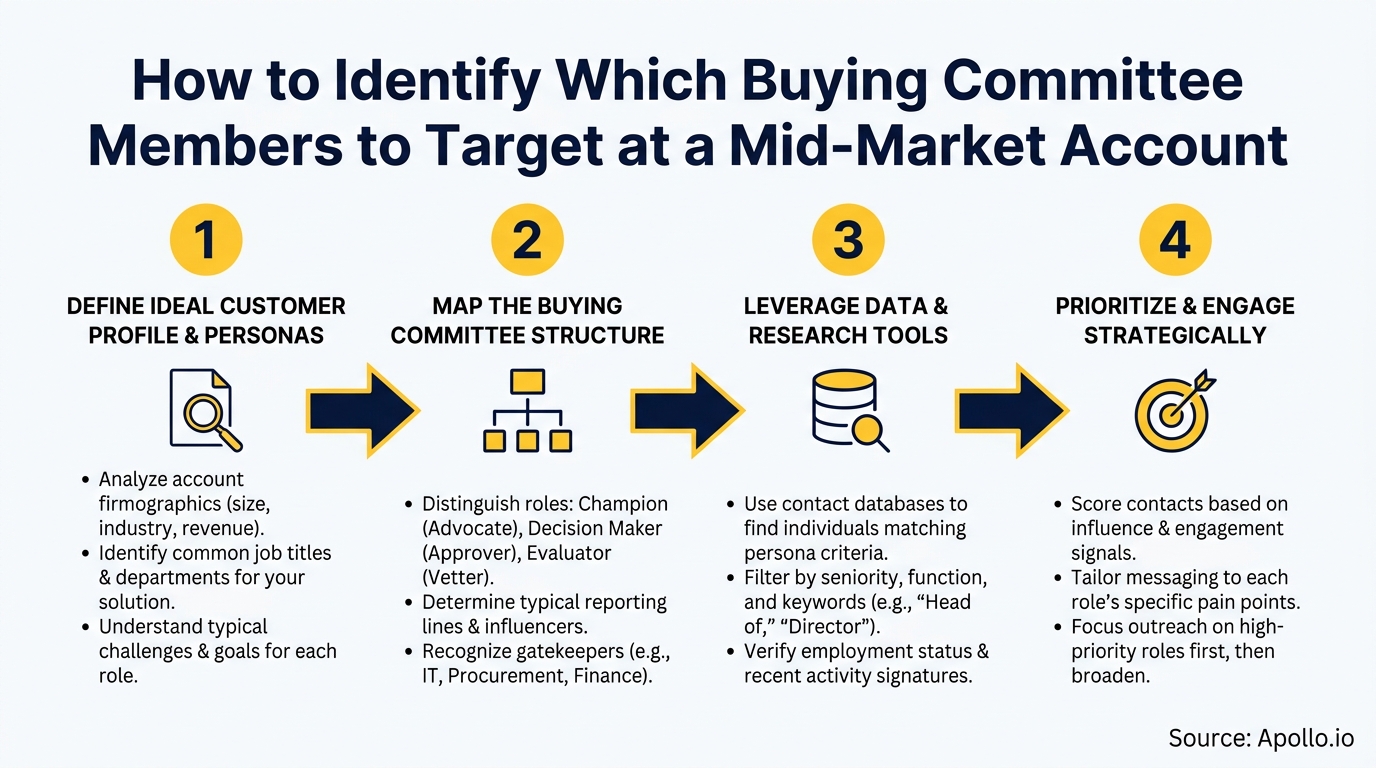
Identifying buying committee members starts with combining org-chart signals, intent data, and CRM history to surface who is likely already involved—before you ask your champion.
Use this four-step approach:
- Start with your champion's org chart. Map their direct manager, peers in adjacent teams, and the executive sponsor above them. These three tiers cover most of the committee at mid-market scale.
- Layer in intent signals.Apollo's buying intent data shows which roles at a target account are consuming content related to your category. If IT contacts are reading security comparison content, they're already in the evaluation.
- Check your CRM for prior touches. Accounts that have been engaged before often have dormant contacts in roles you haven't activated. RevOps leaders find this is a fast source of committee members that reps overlook.
- Use job title clustering. Filter by department and seniority inside your target account to identify likely role gaps—procurement, legal, or finance contacts who haven't been contacted yet.
Struggling to surface all the right contacts at a target account? Search Apollo's 230M+ contacts with 65+ filters to find every stakeholder by title, department, and seniority.

How Do AEs Prioritize Which Committee Members to Engage First?
AEs should prioritize committee members based on deal stage, influence level, and how close each role is to causing a stall. Not every member needs equal attention at every stage.
A practical prioritization framework by deal stage:
- Early stage: Champion first, then end users. Build momentum and gather internal intelligence before escalating.
- Mid stage: Economic buyer and technical approver. Both need separate, role-specific conversations—don't loop them in with the same deck.
- Late stage: Procurement and legal. Engage these roles proactively with a vendor due diligence kit rather than waiting for them to raise objections.
Data from Thunderbit highlights why this matters: Forrester's 2024 report indicates that 86% of B2B purchases stall, and 81% of buyers are dissatisfied with their chosen provider—stalls tied directly to misalignment among stakeholders who were never properly engaged.
For Account Executives managing complex mid-market cycles, the goal isn't to contact everyone simultaneously. It's to sequence outreach so each role receives the right message at the moment their concern becomes relevant to the deal.
Turn Weak Funnels Into Pipeline Gold
Pipeline forecasting a guessing game? Apollo surfaces in-market buyers the moment they're ready, turning cold funnels into qualified opportunities. Join 600K+ companies that stopped guessing and started closing.
Start Free with Apollo →What Content Should You Send Each Committee Role?
Each committee member needs content that addresses their specific buying job, not a generic product overview. Role-specific messaging reduces outreach irrelevance and makes it easier for your champion to share materials internally.
| Role | Content That Works |
|---|---|
| CFO / Economic Buyer | ROI model, payback calculator, business case template |
| IT / Security | Security overview, integration specs, architecture diagram |
| Procurement | Vendor due diligence kit, contract summary, reference list |
| End Users | Product walkthrough, peer case studies, onboarding timeline |
| Legal / Compliance | Data handling summary, DPA overview, relevant certifications |
Equip your champion with forwardable, one-page summaries for each role. This enables self-serve evaluation—which matters because The Insight Collective reports that among B2B tech buyers, directors and VPs represent the largest segment at 32%, followed by managers at 22%—both groups who prefer to research independently before engaging a rep.
Learn how intent data powers smarter B2B outreach by surfacing which roles are already self-educating on your category.

How Do SDRs Build a Multi-Threaded Outreach Plan for a Mid-Market Account?
SDRs build multi-threaded outreach by mapping at least three distinct contacts per account before the first touch—champion, economic approver, and one technical or operational stakeholder.
Practical steps for SDRs:
- Use your target account list to segment contacts by department within each account.
- Write separate first-touch messages for each role. The champion message focuses on workflow impact; the economic buyer message focuses on cost and risk.
- Sequence touches so that if the champion goes dark, you have an active thread with a secondary contact—preventing single-point-of-failure pipeline.
- Track which roles have been contacted and which are gaps. Coverage scoring (champion engaged, economic buyer contacted, technical approver identified) is a more reliable pipeline health metric than MQL counts alone.
Spending too much time manually researching contacts at each account? Apollo's multi-channel sequences let SDRs run role-specific outreach across email, phone, and social from one workspace—without juggling separate tools.
For teams building this process from scratch, the sales prospecting list guide covers how to structure account-level contact lists that support multi-threaded outreach at scale.
Start Mapping Your Mid-Market Buying Committees Today
Identifying buying committee members isn't a one-time research task—it's an ongoing process that evolves as deals progress and new stakeholders surface. The teams that win mid-market consistently are the ones who treat committee coverage as a measurable metric, not an afterthought.
Apollo gives GTM teams a unified platform to find committee members, enrich contact data, track intent signals, and run role-specific outreach sequences—all without stitching together five separate tools. As Census put it: "We cut our costs in half." And Cyera noted: "Having everything in one system was a game changer."
Ready to map your next mid-market account committee and reach every stakeholder with the right message? Schedule a Demo and see how Apollo consolidates prospecting, enrichment, intent data, and engagement in one platform.
Prove Pipeline ROI With Apollo
ROI pressure killing your tool budget? Apollo delivers measurable pipeline impact from day one — no guesswork, no waiting. Leadium 3x'd annual revenue. Start yours free today.
Start Free with Apollo →Don't miss these
Sales
Inbound vs Outbound Marketing: Which Strategy Wins?
Sales
What Is a Sales Funnel? The Non-Linear Revenue Framework for 2026
Sales
What Is a Go-to-Market Strategy? The 2026 GTM Playbook
See Apollo in action
We'd love to show how Apollo can help you sell better.
By submitting this form, you will receive information, tips, and promotions from Apollo. To learn more, see our Privacy Statement.
4.7/5 based on 9,690 reviews
