
B2B Sales: Definition, Process, and Strategies That Drive Revenue
B2B sales has fundamentally shifted. Buyers now control the process, preferring self-service over traditional sales reps. According to Gartner, 61% of B2B buyers preferred a rep-free buying experience in 2024. This means your sales approach must adapt to buyer expectations, digital channels, and cross-channel consistency. This guide defines B2B sales in 2026 and shows how modern teams win with proven B2B sales strategies.

Apollo Finds Verified Contacts In Seconds
Tired of spending 4+ hours daily hunting for contact info? Apollo delivers 224M contacts with 96% email accuracy—no more manual research. Join 550K+ companies closing deals faster.
Start Free with Apollo →Key Takeaways
- B2B sales means selling products or services from one business to another, not to individual consumers.
- Modern B2B buyers prefer digital self-service channels over traditional sales rep interactions.
- Trust depends on consistent information across all channels, with 69% of buyers reporting website inconsistencies.
- SDRs and AEs need unified platforms to manage prospecting, outreach, and deal tracking in one workspace.
- Successful B2B sales teams consolidate tools to reduce complexity and cut costs while improving buyer experience.
What Is B2B Sales?
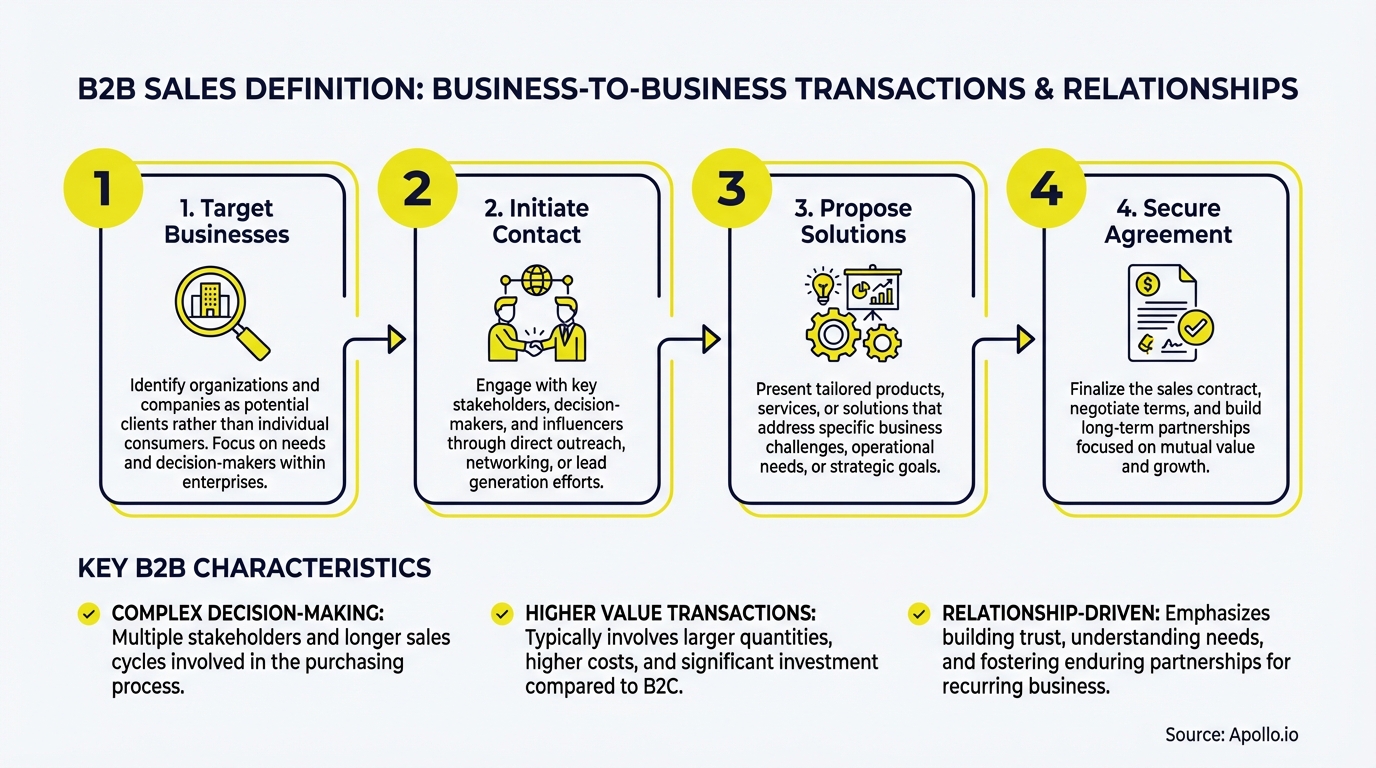
B2B sales (business-to-business sales) is the process of selling products or services to other businesses rather than individual consumers. Unlike B2C transactions, B2B sales involve longer sales cycles, multiple decision-makers, and higher transaction values.
Businesses purchase solutions to solve operational challenges, improve efficiency, or generate revenue.
B2B sales encompasses everything from SaaS subscriptions to industrial equipment, consulting services to wholesale goods. The key distinction is that your customer is a business entity making purchasing decisions through formal procurement processes. Understanding B2B sales meaning helps teams align their approach to complex buying committees and extended evaluation periods.
How Does B2B Sales Differ from B2C Sales?
B2B sales differs from B2C in buyer behavior, decision-making, and sales approach. B2C transactions are typically emotional, quick, and involve single buyers.
B2B purchases are rational, slow, and require consensus from multiple stakeholders.
| Factor | B2B Sales | B2C Sales |
|---|---|---|
| Decision-Makers | Multiple stakeholders (executives, end-users, procurement) | Individual consumer |
| Sales Cycle | Weeks to months (sometimes years for enterprise) | Minutes to days |
| Transaction Value | High (thousands to millions) | Low (tens to hundreds) |
| Purchase Motivation | ROI, efficiency, business outcomes | Personal needs, emotions, lifestyle |
| Relationship | Long-term partnerships with ongoing support | Transactional with limited post-sale engagement |
B2B buyers conduct extensive research before engaging sales teams. They compare vendors, request demos, negotiate contracts, and require implementation support. This complexity demands specialized sales skills and tools designed for B2B sales organizations.
Spot In-Market Buyers Before Competitors Do
Missing deals because you can't see who's ready to buy? Apollo reveals buyer intent signals and tracks website visitors so you reach prospects at the perfect moment. Built-In increased win rates 10% with Apollo's scoring.
Start Free with Apollo →What Are the Key Components of B2B Sales in 2026?
Modern B2B sales combines digital self-service with strategic human interaction. Buyers want control over their journey while accessing expert guidance when needed.
The key components include verified contact data, multi-channel engagement, conversation intelligence, and unified deal management.
Data quality forms the foundation. Sales teams need accurate business contact information to reach decision-makers. Struggling to find qualified leads? Search Apollo's 224M+ contacts with 65+ filters. Multi-channel sequences combine email, phone, and social outreach to meet buyers where they engage. Conversation intelligence captures insights from calls and meetings, while deal management tracks opportunities through complex sales cycles.
The shift toward buyer-controlled experiences means sales teams must maintain consistent messaging across every touchpoint. Research by Gartner found that 69% of B2B buyers reported inconsistencies between information on websites and what sellers told them. This trust gap kills deals before they start.
How Do SDRs Generate Pipeline with Modern B2B Sales?
SDRs (Sales Development Representatives) generate pipeline by identifying ideal prospects, executing personalized outreach, and qualifying leads for Account Executives. In 2026, successful SDRs use intent data to prioritize accounts showing buying signals.

The modern SDR workflow includes:
- Prospecting: Search contact databases using filters like job title, company size, industry, and technology stack
- Research: Review company news, funding announcements, and hiring patterns to personalize messaging
- Outreach: Execute multi-channel sequences combining email, phone calls, and social engagement
- Qualification: Assess prospect fit using frameworks like BANT (Budget, Authority, Need, Timeline)
- Handoff: Transfer qualified opportunities to AEs with context and next steps
Top-performing SDRs book more meetings by consolidating their tech stack. "We reduced the complexity of three tools into one," reports Predictable Revenue. Instead of juggling separate tools for data, outreach, and tracking, unified platforms eliminate context switching and improve efficiency.
What Challenges Do B2B Sales Teams Face in 2026?
B2B sales teams face three critical challenges: buyer preference for self-service, tool sprawl complexity, and maintaining trust through consistent messaging. The rep-free buying trend forces sellers to add value beyond information delivery.
Buyers can research independently, so sales teams must provide strategic insights and personalized guidance.
Tool sprawl creates operational chaos. Sales teams often use separate platforms for prospecting, enrichment, outreach, meeting scheduling, call recording, and CRM updates.
This fragmentation leads to data silos, manual work, and missed opportunities. "We cut our costs in half," says Census after consolidating to a unified platform.
Trust erosion from inconsistent messaging damages conversion rates. When website content contradicts sales conversations, buyers question your credibility. Sales leaders must enforce cross-channel governance to ensure every touchpoint delivers accurate, aligned information. Spending hours on manual outreach? Automate your sequences with Apollo's multi-channel platform.
How Can Account Executives Close More B2B Deals?
Account Executives close more B2B deals by leading with insights, aligning to buyer timelines, and orchestrating multi-stakeholder consensus. Modern AEs act as trusted advisors who understand prospect challenges and map solutions to business outcomes.
Winning strategies include:
- Discovery: Ask questions that uncover pain points, priorities, and success metrics
- Value Mapping: Connect product capabilities to specific business impacts with quantified ROI
- Stakeholder Alignment: Identify all decision-makers and address individual concerns
- Objection Handling: Proactively surface and resolve concerns throughout the cycle
- Momentum Management: Drive urgency with clear next steps and mutual action plans
For Account Executives managing complex deals, enterprise sales strategies provide frameworks for navigating buying committees. AEs who master multi-threading (engaging multiple stakeholders simultaneously) reduce deal risk and accelerate close rates. "Having everything in one system was a game changer," notes Cyera when describing consolidated deal tracking and communication history.
Start Winning with Modern B2B Sales
B2B sales in 2026 requires adapting to buyer preferences for self-service while delivering strategic value through every interaction. Success depends on verified data, consistent cross-channel messaging, and unified platforms that eliminate tool complexity.
Sales teams that consolidate their tech stack close deals faster while reducing operational costs.
Whether you're an SDR prospecting for qualified leads, an AE managing complex deals, or a sales leader building scalable processes, the right platform makes the difference. Apollo provides 224M+ verified business contacts, multi-channel engagement sequences, conversation intelligence, and complete deal management in one unified workspace.
Over 550,000 companies trust Apollo to power their go-to-market strategy.

Ready to transform your B2B sales process? Get Leads Now and experience how Apollo consolidates your entire sales workflow into one powerful platform.
Prove Apollo's ROI In Your First 30 Days
Budget approval stuck on unclear metrics? Apollo tracks every touchpoint from first contact to closed deal—quantify time saved, pipeline impact, and win rate improvements. Built-In increased win rates 10% and ACV 10% with Apollo's scoring.
Start Free with Apollo →Don't miss these
Sales
Inbound vs Outbound Marketing: Which Strategy Wins?
Sales
What Is a Sales Funnel? The Non-Linear Revenue Framework for 2026
Sales
What Is a Go-to-Market Strategy? The 2026 GTM Playbook
See Apollo in action
We'd love to show how Apollo can help you sell better.
By submitting this form, you will receive information, tips, and promotions from Apollo. To learn more, see our Privacy Statement.
4.7/5 based on 9,690 reviews
