

Your sales organization is spending an average of $1,200 per rep annually on sales tools, yet 67% of purchased features go unused. According to Gartner, IT spending is growing 9.3% in 2025, but most C-suite teams can't answer a simple question: what revenue did last quarter's tech investment actually generate? Apollo.io explains what C-suite executives should understand about sales tech stack ROI.
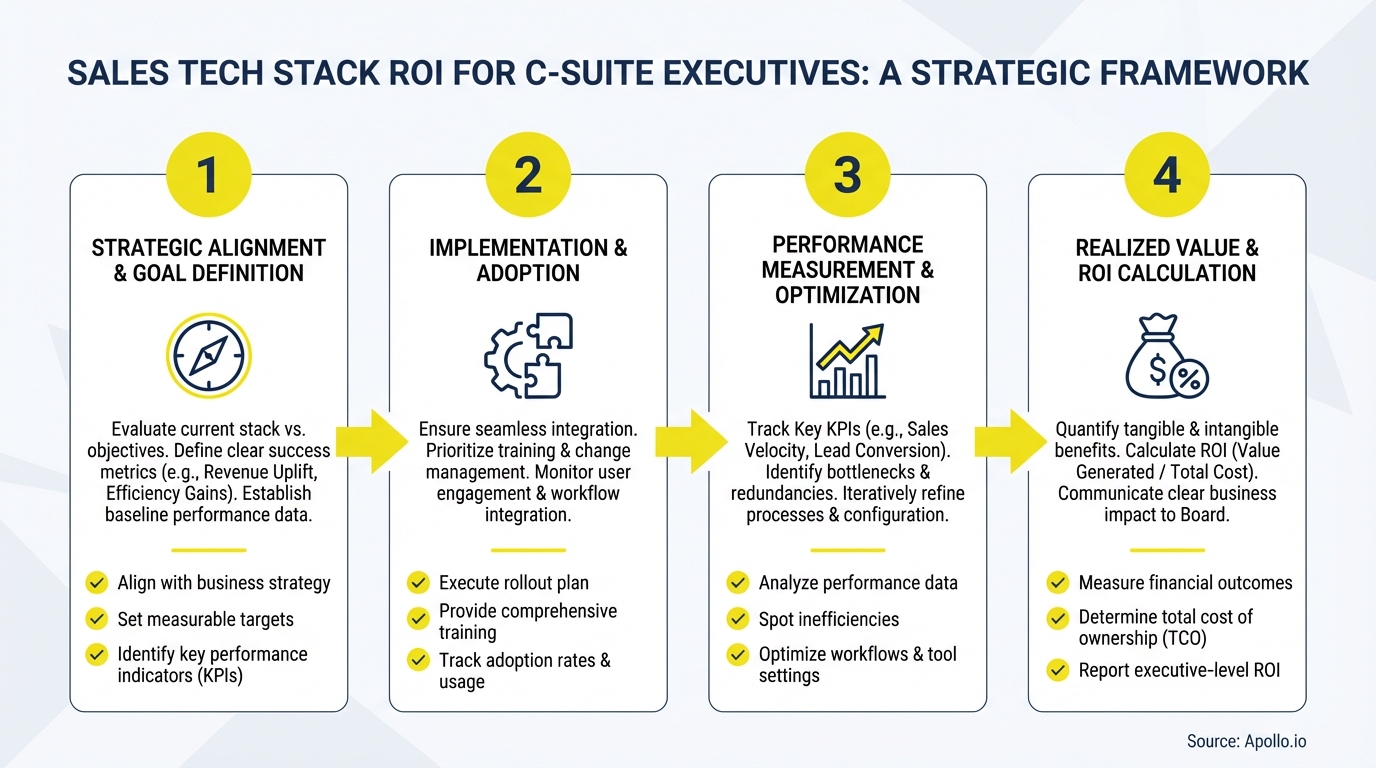
Key Takeaways
- Stop tracking adoption rates, measure revenue impact per dollar spent on each tool in your stack
- According to ICONIQ, 2025 State of AI Report, 47% of AI-native companies have reached critical scale and proven market fit, compared to only 13% of companies that simply "enabled" existing products with AI features
- Your biggest waste isn't the tools you bought, it's the duplicate data, disconnected systems, and time reps spend toggling between platforms
- Build ROI models that account for implementation drag, training costs, and the productivity dip before value kicks in
What's actually broken with sales tech stack ROI?
The problem isn't that your sales tools don't work. It's that nobody knows what "working" means in dollars and cents.
Your CRO says the new engagement platform increased activity by 40%. Your CFO asks how much revenue that activity generated.
Silence.
Here's what's happening: Each department bought tools to solve its own problems. Sales got a dialer and sequencing platform.
Marketing added attribution software and a customer data platform. RevOps implemented data enrichment and analytics.
Nobody mapped how these systems work together, and now you're paying for three different contact databases that don't sync, two conversation intelligence platforms that capture different calls, and four reporting dashboards that show conflicting numbers.
The financial impact is measurable. When your VP of Sales presents pipeline growth, she's using data from the customer relationship management tool.
When your CMO shows marketing-influenced revenue, he's pulling from the marketing automation platform. When your CFO asks why customer acquisition cost increased 23% while conversion rates stayed flat, nobody can connect the dots because the data lives in silos.
Research from Gartner found that 65% of B2B sales organizations will transition from intuition-based to data-driven decision making by 2026. But you can't make data-driven decisions when your data is fragmented across disconnected systems.
The real cost isn't the subscription fees. It's the revenue you're not closing because reps spend too much of their time on nonselling tasks, updating multiple systems, searching for contact information that exists in three different databases with three different versions, and attending training sessions for tools that overlap with tools they already use.
What metrics actually matter for measuring tech stack ROI?
Track revenue per tool dollar, not feature adoption. The question isn't whether your team uses the new platform. The question is whether using it generates more revenue than it costs.
Here's what to measure: Calculate the fully loaded cost of each tool (subscription + implementation + training + ongoing management + integration maintenance). Then measure the incremental revenue impact.
If your engagement platform costs $180,000 annually all-in and increases closed-won revenue by $500,000, that's a 2.8x return. If your conversation intelligence platform costs $120,000 and you can't quantify the revenue impact, that's a problem.
Stop measuring vanity metrics like "emails sent" or "calls logged." Measure business outcomes: pipeline created per dollar spent, revenue influenced per tool investment, time saved that converts to actual selling hours. When Pipeline360 surveyed B2B marketers for its 2025 State of the B2B Pipeline report, it found that teams want results, not more technology. The same applies to sales tech, your board wants ROI, not dashboards showing how many features you've activated.
Track integration costs as a separate line item. Every new tool requires connections to your CRM, your data warehouse, your analytics platform, and your other sales tools.
Those integrations break. They require ongoing maintenance.
They create data sync issues. Calculate the monthly cost of keeping your stack connected, it's often 20-30% of your total tech spend.
Measure the productivity dip during implementation. When you roll out a new platform, rep productivity drops for 4-8 weeks while they learn the system.
Calculate that cost. If you have 50 reps averaging $500K in annual quota, a 6-week productivity dip at 30% reduced output costs you $865,000 in delayed revenue.
Your ROI model must account for this.

Why are AI-native tools outperforming legacy platforms?
AI-native tools eliminate manual work instead of creating new workflows. Legacy tools add steps, log this call, update this field, and create this task.
According to ICONIQ, 2025 State of AI Report, they observe that 47% of AI-native companies have reached critical scale and proven market fit, compared to only 13% of companies that simply "enabled" existing products with AI features.
AI-native tools remove steps by automating the busywork entirely.
But that number is misleading if you don't understand why. The ROI isn't from the AI itself.
It's from what the AI eliminates.
When a rep uses a legacy dialer, they manually pull a list, upload it, dial through prospects, log each call outcome, update the CRM record, schedule the next task, and repeat. An AI-native system does all of that automatically while the rep focuses on the actual conversation.
The ROI comes from converting nonselling hours into selling hours.
The trap: Adding AI features to your existing stack without removing the old workflows. If your team is using an AI email writer but still manually personalizing every message because they don't trust the output, you've added cost without eliminating work.
Real ROI requires replacing old processes, not supplementing them.
Here's the evaluation framework: For every AI tool you're considering, identify exactly which manual tasks it eliminates. If it doesn't remove at least 3 hours per rep per week of current work, the ROI won't justify the investment.
You're not buying AI. You're buying back your reps' time to sell.
What does tech stack consolidation actually look like?
It means cutting tools, not adding integrated platforms.
They're swapping 10 point solutions for 3 "comprehensive platforms" that still don't talk to each other.
Real consolidation starts with a capability audit. List every sales tech tool you're paying for.
Map what each one does. Identify the overlaps.
Most organizations discover they're paying for the same capability 3-4 times across different platforms.
Example: You have contact data in your CRM, your engagement platform, your conversation intelligence tool, and your data enrichment service. Each one charges based on contact volume.
Each one maintains a separate database. When a phone number changes, it gets updated in one system but not the others, so your reps waste time calling dead numbers.
You're paying four times for data that should live in one place.
The consolidation decision: Choose platforms that replace multiple tools, not platforms that integrate with everything. Integration sounds good until you're paying a developer $150/hour to fix broken syncs every quarter.
The real ROI comes from reducing the number of systems that need to stay connected.
Calculate your "integration tax", the total cost of keeping your current stack working together. Include API costs, developer time, data sync failures, and the opportunity cost when reps can't access information because a connection broke.
For most organizations, the integration tax is 25-40% of total tech spend. Consolidation eliminates that entirely.
How do you build an ROI model that executives actually trust?
Start with real costs, not list prices. When your sales tech vendor quotes $50,000 annually, the actual cost is $50,000 plus implementation (typically 20-30% of annual cost), plus training (calculate hours times burdened labor cost), plus integration (developer time to connect it to your stack), plus ongoing management (who owns this tool and how much of their time does it consume?).
For a $50,000 platform, your all-in first-year cost is usually $75,000-$90,000. Your steady-state annual cost after year one is $60,000-$70,000.
Use these real numbers in your ROI calculations, not the subscription fee.
Build your revenue impact model bottom-up, not top-down. Don't say "this will increase win rates by 10%." Say "this eliminates 5 hours per rep per week of manual data entry.
We have 40 reps. That's 200 hours per week, or 10,400 hours annually.
At an average hourly rate of $150 for selling time, that's $1.56M in recaptured selling capacity. If they convert that time at our average efficiency, it generates $468K in additional revenue."
Show the board three scenarios: conservative (tool delivers 50% of promised value), expected (tool delivers 80% of promised value), and optimistic (tool delivers 100% of promised value). Use the conservative case for your go/no-go decision.
If the ROI works in the conservative scenario, approve it. If it only works in the optimistic scenario, pass.
Track actual performance against your model quarterly. Most organizations build an ROI model to justify the purchase, then never look at it again.
The CFO's question six months later, "Is this actually delivering what you said it would?" - catches everyone off guard. Build quarterly check-ins into your implementation plan.
Measure the actual impact. If it's not hitting your conservative case by quarter two, you either fix the implementation or cut the tool.

What questions should you ask before approving the next sales tech investment?
Start with: "What manual work does this eliminate, and how many hours per rep per week?" If the answer is vague or starts with "Well, it helps reps be more efficient," that's a no. You need specific workflows that get removed entirely.
Ask: "What tools does this replace?" If the answer is "It integrates with everything we already have," you're adding to the stack, not consolidating. The ROI case should include the cost savings from retiring old tools, not just the incremental value from the new one.
Demand: "Show me the fully loaded three-year cost." Get implementation costs, integration costs, training costs, and ongoing management costs in writing. Add 20% for unknowns.
Use that number in your ROI model, not the annual subscription fee.
Require: "What's our exit strategy?" If this doesn't work out, what does it cost to switch? How hard is it to extract our data?
What happens to our workflows? You're not planning to fail, but you're planning for the possibility that the tool doesn't deliver.
Build that exit cost into your decision framework.
Challenge: "What's the productivity dip during rollout?" Get specific. How many weeks will reps be less productive?
By what percentage? Who's responsible if the actual dip is worse than projected?
Calculate that cost and add it to your ROI model.
Finally, ask: "Who owns this tool, and what happens to their other responsibilities?" Every platform needs someone to manage it, configurations, user support, integration monitoring, vendor management. If you're adding work to someone's plate without removing something else, you're creating ROI drag.
Factor in the management cost or plan to hire for it.
How do you make the final decision on tech stack investments?
Use a scoring framework that weights ROI above everything else. Create a simple decision matrix: ROI (50% weight), strategic fit (20%), implementation risk (15%), vendor stability (15%).
Score each potential investment 1-10 in each category. Multiply by weights.
Anything below 7.0 overall is a pass.
For the ROI component, use your conservative scenario model. If the tool delivers $3 in revenue for every $1 spent, that's a 10.
If it breaks even, that's a 5. If it costs more than it returns, that's a 0.
Be ruthless here, most vendors will show you optimistic case studies that assume perfect implementation and full adoption. Cut their projected impact in half and use that for your score.
Run a pilot before full deployment. Pick 10 reps, implement the tool properly, and measure the results for 90 days.
If the pilot doesn't show measurable improvement in your key metrics (pipeline created, revenue closed, time saved), don't scale it. The vendor will say "You need full adoption for it to work." That's often true, but if you can't prove value with 10 engaged users, you won't see it with 100 skeptical ones.
Set kill criteria upfront. Before you buy, agree on what "not working" looks like.
Example: "If we don't see a 15% improvement in connect rates by month six, we cancel." Put it in writing. Share it with the vendor.
When month six arrives and you're at 8% improvement, you have a clear decision framework instead of a political debate about sunk costs.
Remember: The best sales tech investment is often the one you don't make. Your stack is already too complex.
Your reps are already spending too much time on tools instead of selling. Before adding another platform, ask whether you can get the same result by using what you already have more effectively.
The ROI on better process execution is infinite, it costs nothing and generates immediate value.
Share this post
Start using Apollo today
Start your free trial with Apollo today—then use these resources to guide you through every step of the process.

Start using Apollo today
Start your free trial with Apollo today—then use these resources to guide you through every step of the process.
or
By signing up, I agree to Apollo's Terms of Service and Privacy Policy.
Continue Learning
Explore these handpicked resources to deepen your understanding of AI-powered GTM
9 Sales Tasks AI Agents Now Handle, and 4 Humans Still Own
AI agents are cutting prospect research time by 34% and email drafting by 36%. See the 9 sales tasks shifting to AI in 2026, and the 4 that stay human.
The Toggle Tax: What 1,200 Daily App Switches Are Quietly Costing Sales Teams
Sales reps spend only 40% of their week actually selling. See what the toggle tax costs the other 60%, and how to close the gap.
Agentic GTM, Explained: What Changes When Sales Agents Run the Workflow
83% of AI-using sales teams report revenue growth (Salesforce). See what separates autonomous sales agents from AI features, and what changes by 2028.