GTM Platform Consolidation: What C-Suite Executives Must Know

Why C-Suite Executives Are Paying for Five Platforms When One Could Do the Job
Your marketing team uses HubSpot. Sales runs Salesforce with Outreach bolted on. Customer success lives in Gainsight. Meanwhile, you're paying for ZoomInfo, Clearbit, and three other data vendors to fill the gaps between systems that don't talk to each other. Apollo.io explains what C-suite executives should understand about GTM platform consolidation before your next board meeting.
Key Takeaways
- Your fragmented tech stack costs 3-5x more than consolidation when you account for integration fees, training time, and data sync failures
- Platform consolidation isn't about cutting tools, it's about eliminating the coordination tax between departments that use different systems
- The right consolidation strategy starts with mapping data flow, not vendor demos
- Successful consolidation requires executive alignment across revenue, finance, and technology before evaluating platforms
What's the real cost of GTM platform fragmentation?
The direct costs are obvious in your P&L: $50K for the CRM, $30K for the engagement platform, $40K for data enrichment, another $25K for conversation intelligence. But those line items don't capture the real damage.
Your sales team logs activities in Salesforce, sends sequences from Outreach, pulls data from ZoomInfo, and records calls in Gong. Each handoff between systems creates friction, data loss, and wasted time.
When your VP of Sales asks why conversion rates dropped, nobody can answer with confidence because the data lives in four places with different timestamps and conflicting information. According to Gartner research, 74% of B2B buyer teams demonstrate unhealthy conflict during decision processes, and your own internal teams face the same dysfunction when they can't agree on basic pipeline metrics because everyone's looking at different systems.
The hidden costs show up in three places your CFO should track closely. First, integration maintenance burns 20-30% of your revenue operations budget keeping APIs connected and data flowing.
Second, every new hire needs training on five platforms instead of one, extending ramp time by weeks. Third, your best reps spend hours each week on data entry and reconciliation instead of selling.
When you calculate fully loaded costs including personnel time, most companies discover they're spending 3-5x what the vendor invoices suggest.
What problems does platform consolidation actually solve?
Consolidation eliminates the coordination tax between teams that operate in separate systems. When marketing, sales, and customer success all work in the same platform, you stop arguing about whose numbers are right and start focusing on what to do with accurate information everyone trusts.
The first problem consolidation solves is the attribution nightmare. In fragmented stacks, marketing claims credit for leads that sales says they found themselves.
Customer success can't see what was promised during the sales cycle. Nobody knows which activities actually drive pipeline because the data trail breaks between systems.
A unified platform creates a single source of truth where every interaction is tracked in context, so you can finally answer basic questions like "what's working?" with data instead of opinions.

The second problem is velocity. Research from McKinsey's B2B Pulse 2024 shows that top-performing B2B companies excel at speed and execution. When your team wastes 30 minutes per day switching between tools and manually syncing data, you're giving competitors with consolidated stacks a structural advantage. Consolidation removes friction so your team can act on opportunities immediately instead of waiting for data to sync or switching contexts between platforms.
The third problem is strategic visibility. When your GTM data is scattered across platforms, you can't spot patterns or make intelligent tradeoffs.
A consolidated platform lets you see which market segments convert fastest, which messaging resonates with different personas, and where deals stall, all without running custom reports or hiring analysts to stitch data together from multiple sources.
What should C-suite executives evaluate before consolidating?
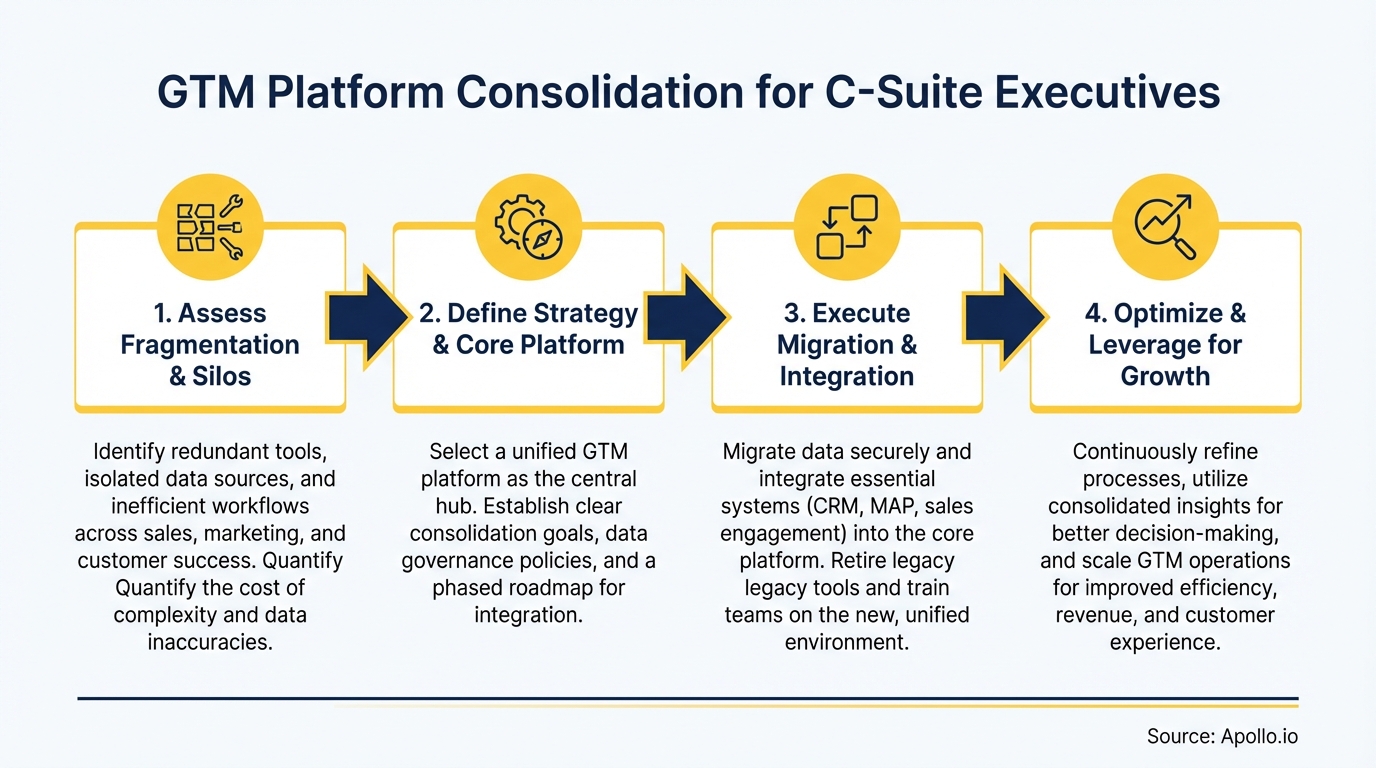
Start by mapping your actual data flow, not your org chart. Draw out how a prospect becomes a customer in your business today.
Where does data originate? What systems touch it?
Where do handoffs happen? Where does information get lost or duplicated?
This exercise reveals which integrations are critical versus nice-to-have, and shows you where consolidation creates the most value.
Next, calculate your true cost of ownership across the current stack. Add up direct software costs, integration and API fees, personnel time for data management, training costs, and the opportunity cost of delays caused by system friction.
Most executives significantly underestimate total costs because they only look at vendor invoices. When you include fully loaded costs, the ROI case for consolidation becomes much clearer.
Then assess your organizational readiness. According to Gartner research, 61% of B2B buyers prefer a rep-free buying experience, which means your GTM motion needs to support both human-led and digital-first engagement. That requires alignment between marketing, sales, and customer success, not just at the executive level, but in how teams actually work day-to-day. If your CRO and CMO barely speak to each other, consolidating their platforms won't magically fix the underlying dysfunction. Address the organizational issues first, or you'll just move silos into a single expensive platform.
Finally, define your non-negotiables before vendor demos. What capabilities must exist in the consolidated platform versus what you're willing to give up?
Where do you need best-in-class functionality versus good-enough? Which integrations are truly essential?
Having clear answers prevents vendor demos from becoming feature bingo where every bell and whistle seems important.
What metrics indicate consolidation is working?
Track time to revenue, not just cost savings. Yes, you should see reduced software spend and lower integration costs.
But the real wins show up in faster deal cycles, higher win rates, and improved forecast accuracy. Measure how long it takes a new lead to reach closed-won status before and after consolidation.
If that timeline shrinks by 15-20%, you're removing friction successfully.
Monitor system adoption across departments. In fragmented stacks, different teams naturally gravitate to their preferred tools and ignore others.
After consolidation, track whether marketing, sales, and customer success all use the platform daily. Low adoption in any department signals that either the platform doesn't meet their needs or change management failed.
Either way, you won't realize consolidation benefits until everyone actually uses the system.
Measure data quality improvements. Count duplicate records, incomplete fields, and conflicting information before consolidation.
These numbers should drop significantly once data flows through a single system instead of syncing across multiple platforms. If data quality doesn't improve, question whether you've actually consolidated or just replaced several mediocre systems with one expensive mediocre system.
Watch for productivity gains in unexpected places. Your revenue operations team should spend less time troubleshooting integrations and more time on strategic analysis.
Reps should log fewer support tickets about missing data. Managers should spend less time reconciling reports and more time coaching.
These soft benefits often exceed the hard cost savings but only materialize if you actually redeploy people to higher-value work instead of just cutting headcount.
How do you make the consolidation decision?
Start with a cross-functional buying committee that includes your CRO, CMO, CFO, and CTO. Platform consolidation affects all four domains, and missing any perspective leads to blind spots that derail implementations.
The CFO brings financial discipline and ROI requirements. The CTO ensures technical feasibility and security compliance.
The CRO and CMO represent the end users who will live in the system daily. All four must agree on priorities, or you'll end up with a platform that optimizes for one function at the expense of others.
Ask vendors these specific questions during evaluation: How does data flow between modules in your platform, is it real-time or batch? Where do you rely on third-party APIs versus native functionality?
What happens to our data if we decide to leave your platform in two years? How many customers have successfully migrated from our current stack, and can we talk to three of them?
What does your typical implementation timeline look like, and what's the variance? These questions reveal whether a vendor has genuine consolidation experience or just rebranded their point solution as a platform.
Demand proof of concept with your actual data and workflows. Vendors excel at demos with clean sample data and ideal use cases.
Insist on testing with your messy real-world data, your complex workflows, and your edge cases. A two-week POC with a small team using real scenarios tells you more than six vendor demos.
Watch for friction points, missing capabilities, and workarounds the vendor suggests. If their solution requires multiple workarounds during the POC, imagine what daily life will look like at scale.
Build a migration plan before signing contracts. How will you move data from current systems?
Which historical data needs to migrate versus starting fresh? What's the sequence for moving teams onto the new platform?
How long will you run systems in parallel? Who owns each migration workstream?
A detailed migration plan surfaces hidden costs and timeline risks that vendors conveniently omit from their proposals. If you can't build a credible migration plan, you're not ready to consolidate.
Finally, define success criteria with your board before implementation begins. What specific business outcomes justify the investment and disruption?
Be explicit about timeline expectations, consolidation benefits typically take 6-12 months to fully materialize as teams adapt and optimize workflows. Set interim milestones so you can course-correct if adoption lags or data quality doesn't improve as expected.
The worst outcome is investing in consolidation but never measuring whether it actually delivered the promised value.
Share this post
Start using Apollo today
Start your free trial with Apollo today—then use these resources to guide you through every step of the process.
Start using Apollo today
Start your free trial with Apollo today—then use these resources to guide you through every step of the process.
or
By signing up, I agree to Apollo's Terms of Service and Privacy Policy.
Continue Learning
Explore these handpicked resources to deepen your understanding of AI-powered GTM
9 Sales Tasks AI Agents Now Handle, and 4 Humans Still Own
AI agents are cutting prospect research time by 34% and email drafting by 36%. See the 9 sales tasks shifting to AI in 2026, and the 4 that stay human.
The Toggle Tax: What 1,200 Daily App Switches Are Quietly Costing Sales Teams
Sales reps spend only 40% of their week actually selling. See what the toggle tax costs the other 60%, and how to close the gap.
A CEO’s Guide to GTM: What used to cost millions, now costs $30
AI has changed the economics of GTM. Apollo CEO Matt Curl explains how a workflow that once required a team and millions of dollars now takes 30 minutes, $30, and the right context.
The Open GTM Stack: Why Closed Platforms Are Holding Your AI Back
Closed platforms made sense before AI. Now they're a liability. Here's why your GTM stack needs to be open by design.